
Kalash Valley Travel Guide: Pakistan's Most Unique Culture
This guide covers everything a foreign visitor needs to know to visit Kalash Valley — where the valleys are, how to get there, which festivals to time your trip around, how to behave respectfully as a guest, and what to expect from one of the most singular cultural experiences available to travellers anywhere in the world.
The Quick Guide (At a Glance)
- 01/ Location: Chitral District, Khyber Pakhtunkhwa (KPK), northern Pakistan
- 02/ Language: Kalasha — an ancient Indo-Aryan language with no writing system
- 03/ Key festivals: Chilam Joshi (May), Uchau (August), Chaumos (December)
- 04/ Best time to visit: May for Chilam Joshi festival; September for harvest season
- 05/ Nearest town: Chitral city — approximately 3 hours from Bumburet valley
- 06/ Getting there: Fly Islamabad to Chitral, or drive via Dir and the Lowari Tunnel, and then take a Jeep to Kalash
- 07/ Cultural sensitivity: High — photography norms and sacred site restrictions apply
Tucked into three remote side valleys of the Hindu Kush in northern Pakistan, the Kalash people have maintained a way of life unlike anything else in South Asia — or anywhere else on earth. They are animist in a country that is 97% Muslim. They brew their own wine in a nation where alcohol is largely prohibited. Their women wear elaborately beaded black robes and towering headdresses sewn with shells, buttons, and cowries. They dance at festivals that predate Islam by centuries. And they do all of this in valleys so beautiful, and so cut off from the outside world until recently, that visiting feels less like tourism and more like encountering something that by rights should not still exist.
Who Are the Kalash People?
The Kalash are one of the smallest and most distinct ethnic minorities in the world — a
community of roughly 3,000 to 4,000 people living in three narrow valleys cut into the western
Hindu Kush mountains. Their origins have been debated for over a century. One popular theory,
largely romantic rather than well-supported by current genetic evidence, connects them to
Alexander the Great's soldiers who remained in the mountains after his campaigns through the
region in the 4th century BC. More rigorous modern research suggests the Kalash descend from an
ancient branch of Indo-Aryan people who arrived in the region several thousand years ago and
maintained their pre-Islamic beliefs and practices while the surrounding populations
converted.
Whatever their precise origins, what makes the Kalash extraordinary today is not an ancient DNA
puzzle — it is the living culture that has survived intact into the 21st century. They worship a
pantheon of deities, hold seasonal festivals tied to agriculture and the natural world, maintain
separate spaces called *jestaks* for worship and community gathering, and practice a form of
ancestor veneration that connects daily life to generations of those who came before.
Gilgit
Baltistan — the region that includes Hunza Valley, the
Karakoram Highway, and Pakistan's northern mountains — is not singled out as a specific
high-risk zone within the advisory. Neither is Islamabad or Lahore in the same terms as the
border regions.
The Kalash have faced significant pressure over the centuries. Neighbouring
kingdoms forced conversions at various points in their history — the "Kafir Kalash" label used
historically reflects the Islamic term for non-believers, a name applied by outsiders rather
than one the Kalash chose. The population that once stretched across a much larger region of
what is now Afghanistan and Pakistan has contracted to these three valleys in Pakistan. That
contraction makes what survives here feel both extraordinary and fragile.
"To travel is to discover that everyone is wrong about other countries"
— Aldous Huxley
The Three Valleys — Which One Should You Visit?
-
The Kalash live across three distinct valleys, each with its own character. Understanding the
differences helps you plan a visit that matches what you are looking for.
- Bumburet Valley is the largest, most accessible, and most visited of the three valleys.has the most developed infrastructure for visitors — a wider choice of guesthouses, a larger Kalash population, and the clearest path from Chitral by road. It is where most visitors begin, and for a short trip it is where you will see the most. The trade-off is that Bumburet sees the most tourist traffic, which has brought both economic benefit to the community and some of the cultural friction that comes with sustained outside attention.
- Rumbur Valley is quieter and less visited than Bumburet, reached by a rougher road that branches off the main Chitral route. It has a smaller Kalash population and fewer guesthouses, but many visitors who make the extra effort find it more intimate. The pace is slower and encounters with Kalash families feel less shaped by a community accustomed to cameras.
- Birir ValleyThe most remote of the three, Birir sits furthest from Chitral and is the least visited by foreign tourists. The community here is considered by some researchers to have maintained the most traditional practices of the three valleys. Getting there requires a longer, rougher drive, and accommodation options are limited — but for visitors with a genuine interest in the culture rather than a quick stop, Birir rewards the extra effort significantly.
The Kalash Festivals — The Best Reason to Time Your Visit
-
The Kalash calendar revolves around three major festivals, each tied to a different season and a
different aspect of the agricultural and spiritual year. Visiting during a festival transforms
the experience entirely — these are not performances staged for tourists, but genuine community
celebrations that visitors are welcomed to witness and, in many cases, to join at the edges of.
- Chilam Joshi — May:The spring festival and the most visited by foreign tourists. Chilam Joshi marks the return of the flocks from the high pastures and the arrival of spring in the valleys. Women and girls dress in their finest robes and headdresses. There is communal dancing in the *jestakhan* (the ceremonial space), singing, the lighting of fires, and rituals of purification and blessing. The visual spectacle is extraordinary — the beaded black robes, the marigold headdresses, the rhythmic chain dances — but what makes it moving rather than merely picturesque is the sense that this is a community celebrating something genuinely its own. May is the most popular window for foreign visitors to time a Kalash trip around.
- Uchau — August:The summer festival, less well-known internationally than Chilam Joshi and correspondingly less visited. Uchau celebrates the ripening of crops and the first fruits of the harvest, with offerings made to the deities and communal feasting. August in the valleys is warm and green, and the smaller number of visitors during Uchau makes for a more quietly intimate experience than the spring festival crowds.
- Chaumos — December:The winter solstice festival and arguably the most spiritually significant of the three. Chaumos marks the transition between the old year and the new, involves purification rituals, the lighting of fires, and ceremonies connected to the Kalash deity Balomain. December in the valleys is cold and the logistics of reaching Chitral in winter require planning. Very few foreign visitors make the effort — which is precisely why those who do describe it as the most profound of the three festivals to witness.
What Is Daily Life Like in the Kalash Valleys?
Outside of festival periods, the Kalash valleys are farming communities whose rhythm is shaped by
the agricultural calendar. Terraced fields of wheat, maize, and vegetables line the valley
floors. Orchards of walnut, mulberry, and grape cover the lower slopes. Goats and cattle graze
on the higher pastures in summer and are brought down before the first snows.
Kalash women are unusually visible in public life compared to norms elsewhere in rural KPK —
they move freely through the village, work in the fields, engage directly with visitors, and
take a central role in festival ceremonies. This visibility is often one of the first things
visitors notice and comment on.
The *kafir bash* — the ancestral wooden effigies carved to commemorate Kalash warriors and
hunters — stand in villages and on hillsides throughout the valleys. They are among the most
distinctive visual elements of Kalash material culture, and unlike the festivals, they are
present year-round.
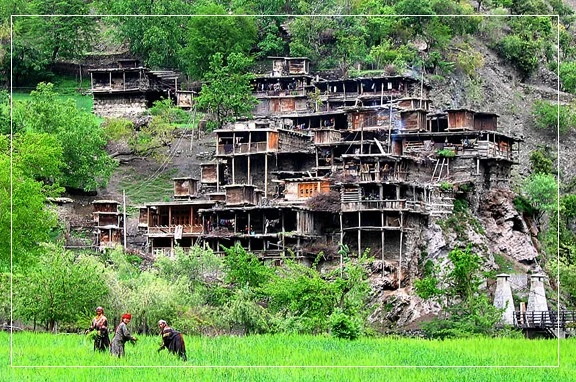
Kalash houses are built in a distinctive stacked style, one structure's roof forming the terrace
of the next, climbing up the valley walls in a way that feels organic rather than planned.
Walking through a Kalash village, particularly in Rumbur or Birir, gives a sense of a built
environment shaped entirely by local materials, local knowledge, and centuries of continuous
occupation.
How to Visit Respectfully
-
The Kalash community is small, and the impact of tourism — both positive and negative — falls
directly on a few thousand people. How you behave as a visitor matters here more than in most
places.
- Photography is perhaps the most sensitive area of a Kalash visit. Many Kalash people, particularly older women, do not wish to be photographed — and a history of visitors pointing cameras without asking has created real tension in some communities. The rule is simple: ask first, accept a no gracefully, and never photograph sacred spaces, ceremonial areas, or *jestakhan* interiors unless you have been explicitly invited. If someone poses for a photograph, a small contribution or the purchase of a handicraft is a respectful response rather than simply moving on.
- The *jestakhan* — the ceremonial spaces where Kalash worship and community rituals take place — are not open to non-Kalash visitors except during festival periods when guests are specifically welcomed. Do not enter these spaces without an invitation.
- Modest dress is respectful in the valleys. This is practical as well as cultural — the mountain environment means layering is sensible regardless of the season.
- The Kalash produce their own grape wine, which is a meaningful part of their cultural and social life. It is offered to guests in some contexts and sold in others. Accept or decline graciously — do not treat it as a curiosity to photograph or post about in ways that reduce a complex cultural practice to a novelty.
- The most direct way to contribute positively to the Kalash community is to spend money within it — staying at Kalash-owned guesthouses rather than non-Kalash operated accommodation in Chitral, buying handicrafts directly from Kalash women rather than from intermediaries, and hiring Kalash guides where available. The economic pressures on the community are real, and where your money goes within the valley matters.
How Do You Get to Kalash Valley?
- Getting to the Kalash valleys requires reaching Chitral first, then travelling the final stretch
by road.
- Chitral by airPakistan International Airlines operates flights between Islamabad and Chitral (approximately 1 hour), making this the fastest option. These flights operate on visual flight rules and are frequently subject to weather-related delays or cancellations — build flexibility into your schedule. The flight itself, passing low over the Hindu Kush, is spectacular.
- Chitral by road via the Lowari TunnelThe completion of the Lowari Tunnel transformed overland access to Chitral, eliminating the seasonal closure of the Lowari Pass that previously cut the district off from the rest of Pakistan in winter. The drive from Dir to Chitral through the tunnel takes approximately 1.5 to 2 hours; the full road journey from Islamabad via Peshawar, Swat, and Dir takes roughly 10 to 12 hours and is best split over two days.
- Chitral to Bumburet ValleyFrom Chitral city to Bumburet is approximately 35 kilometres by a mountain road that takes around 1.5 to 2 hours by jeep. The road requires a 4x4 vehicle and an experienced driver. Rumbur branches off the same route; Birir takes a different approach from Chitral and is slightly further. Most visitors to the Kalash valleys incorporate Chitral into a broader KPK itinerary that includes Swat, Dir, and the surrounding mountains — which is both logistically efficient and genuinely rewarding, as the journey through KPK is compelling in its own right.
What Else Is Worth Seeing Near Chitral?
- Chitral Fort and Shahi Masjid:Chitral city's historic fort and the adjacent royal mosque are worth a half-day. The fort was the site of a famous 46-day siege during the 1895 Chitral Campaign — the old walls and the view over the Chitral River give some sense of why control of this valley mattered strategically for so long.
- Shandur Pass:At 3,700 metres above sea level, Shandur Pass is known as the "roof of the world" and hosts the annual Shandur Polo Festival each July — polo played at altitude between teams from Chitral and Gilgit on what is considered the world's highest polo ground. The landscape around the pass is high-altitude steppe of remarkable emptiness and scale.
- Tirich MirAt 7,708 metres, Tirich Mir is the highest peak in the Hindu Kush and dominates the skyline above Chitral on clear days. It is visible from many points in and around the city and from the road approaching the Kalash valleys — a constant, enormous presence above the green valley floor.
Frequently Asked Questions
Yes — the Kalash community is open to respectful foreign visitors and tourism provides meaningful economic benefit to the valleys. The key word is respectful. Visitors who engage with curiosity and genuine interest rather than treating the Kalash as a spectacle are almost universally welcomed warmly. A local guide familiar with Kalash culture is strongly recommended for a first visit — they provide context that transforms what you see and help you navigate the cultural norms correctly.
A minimum of two nights is needed to see Bumburet properly. Three to four nights allows you to also visit Rumbur and experience a more complete picture of the valleys. If you are visiting during Chilam Joshi festival in May, build in extra days on either side — the festival draws significant visitor numbers and flexible scheduling is helpful.
Chitral and the Kalash valleys are visited by foreign tourists regularly and have a good track record of safety for international visitors. Chitral District is distinct from the tribal border areas of KPK that generate the most concern in travel advisories. Standard precautions apply — travel with a reputable local operator, follow current government advisory guidance for KPK, and confirm conditions in the weeks before travel as these can change.
Yes — Kalash women produce embroidered garments, beaded jewellery, and woven textiles that are genuinely made within the community. Buy directly from Kalash artisans where possible rather than from shops in Chitral, both for authenticity and to ensure the economic benefit reaches the people who made the work.
Kafir Kalash" is a historical label applied by outsiders — "kafir" meaning non-believer in Arabic and Urdu, reflecting the label applied to the community by Muslim neighbours. The community calls itself Kalash. Use Kalash rather than Kafir Kalash in any context; the latter is considered disrespectful by the community and by researchers working with them.