
Why Multan Should Be on Every Traveller's Itinerary
It's not an easy destination — the heat alone rules out half the year — but for travelers willing to work around that, Multan rewards the effort more than its near-total absence from international itineraries would suggest.
The Quick Guide (At a Glance)
- 01/ Nicknames:"City of Saints" for its Sufi shrines, and "City of Mangoes" for the Chaunsa and Anwar Ratol varieties grown around it — both well-earned
- 02/ Location:South Punjab, on the Chenab River, roughly 350 km south of Lahore (4–5 hours by road) and served by its own international airport.
- 03/ Best time to visit: October through March. Summers are genuinely extreme, with daytime highs regularly above 40°C and sometimes touching 50°C between May and July.
- 04/ Signature experiancesSufi shrine architecture, blue pottery and camel-skin handicrafts, and — if you can stand the heat — the city's mango season and July Mango Festival.
Ask most foreign travelers planning a Pakistan trip what's on the list, and you'll hear Hunza, Skardu, maybe Lahore for the food and Mughal architecture. Multan rarely comes up — which is strange, because it's one of the oldest continuously inhabited cities in South Asia, home to some of the most striking Islamic architecture on the subcontinent, and a city whose nickname, the "City of Saints," undersells just how much is packed into its old quarter.
The City of Saints: Multan's Sufi Shrine Trail
Multan's defining feature isn't a single monument but a cluster of them: the mausoleums of Sufi
saints who turned the city into a center of Islamic mysticism centuries ago, and whose tombs are
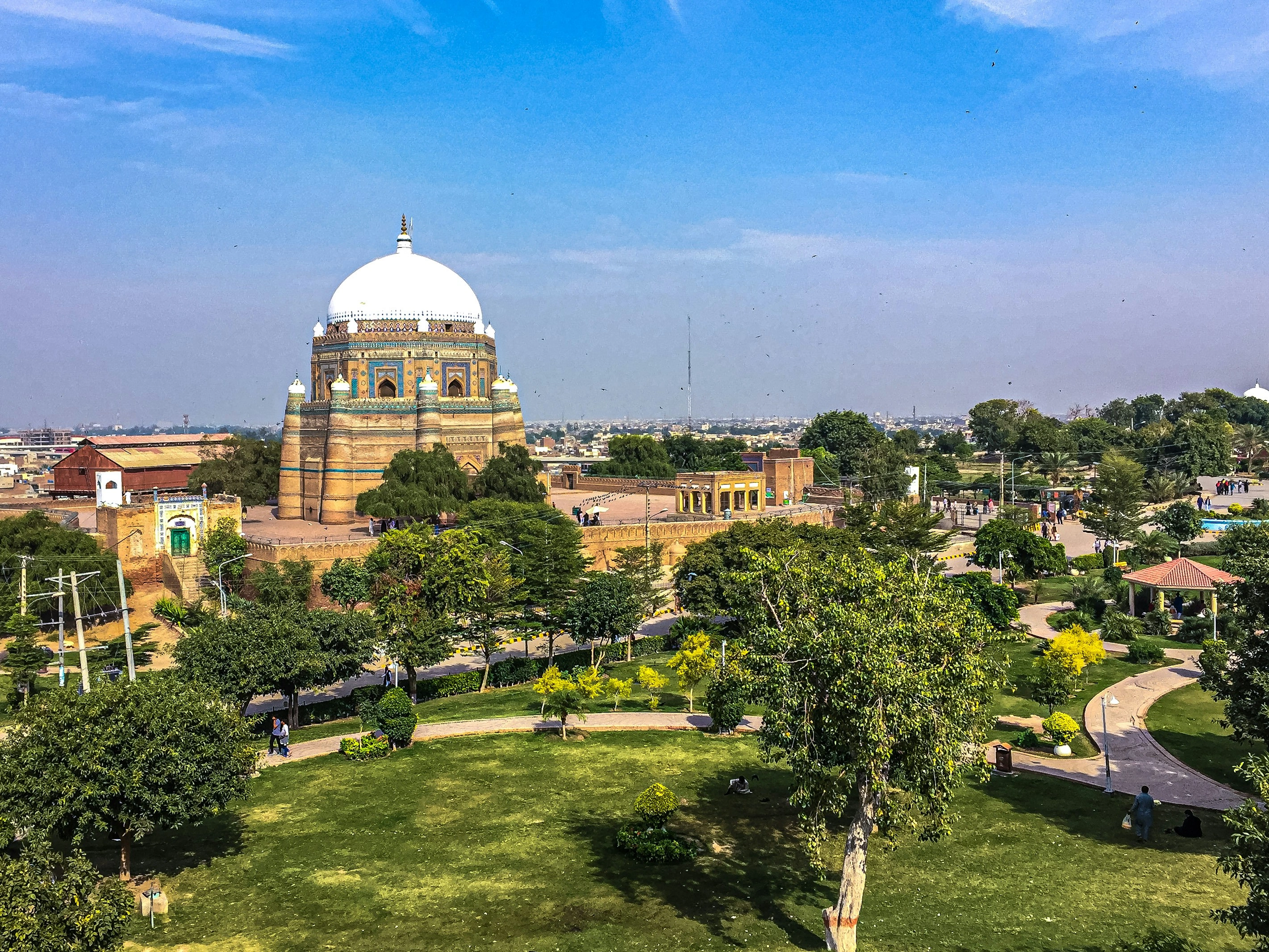
still active sites of pilgrimage rather than roped-off relics. The Tomb of Shah Rukn-e-Alam,
built in the 1320s, is the one that dominates the skyline — a massive octagonal brick structure
visible from well outside the city, decorated with the blue and turquoise tilework that Multan
is known for. Nearby sits the older shrine of his grandfather, Bahauddin Zakariya, founder of
the Suhrawardiyya Sufi order, where you'll typically find devotees reciting verses and
scattering flowers over the grave rather than tourists with cameras.
A short walk or rickshaw ride away, the shrine of Shah Yousaf Gardezi adds another layer to
what's often called Multan's "Sufi trail." If your timing lines up with an Urs — the annual
death-anniversary commemoration for one of these saints, marked with qawwali and large crowds —
you'll see the spiritual side of Multan at full intensity. It's worth visiting early morning if
you'd rather take in the architecture and atmosphere without the crowds, and dressing modestly
is expected at all three sites regardless of when you go.
"To travel is to discover that everyone is wrong about other countries"
— Aldous Huxley
Beyond the Shrines: Things to Do in Multan
The shrines get top billing, but Multan's old city has plenty else going on. Multan Fort (Qila
Kohna) sits on the same elevated mound as Shah Rukn-e-Alam's tomb and gives you a rough sense of
the city's defensive history along with decent views over the rooftops. From there, most people
drift toward Hussain Agahi Bazaar, the city's main market and the best place to actually buy the
blue pottery and camel-skin lamps Multan is famous for — both make far better souvenirs than
anything you'll find in an airport shop.
Ghanta Ghar, the colonial-era clock tower, anchors a busy commercial area that comes alive in
the evening with street food stalls — this is where to try Multani sohan halwa, a dense,
ghee-rich sweet that's become a city export in its own right, alongside chaap (spiced grilled
meat) and the city's better-known biryani. If your trip happens to land in July, the Multan
Mango Festival showcases over 250 mango varieties despite the brutal heat, which gives you some
sense of how seriously the city takes its signature fruit. For something quieter, the Multan
Museum near Saidu Sharif-style heritage sites and a wander through the narrower lanes of the old
city — past Delhi Gate and the smaller neighbourhood mosques — fills out a day nicely without
needing a fixed itinerary.
Planning Your Visit: Getting There, Timing, and Practical Tips for Foreigners
Multan is well connected — Multan International Airport has direct flights from Karachi,
Islamabad, and Lahore, and Pakistan Railways runs daily trains from the major cities if you'd
rather travel overland. By road from Lahore, it's a straightforward 4–5 hour drive via the
motorway network.
Timing matters more here than in most Pakistani cities: October to March is genuinely the only
comfortable window, since summer heat (May through July especially) routinely crosses 40°C and
isn't something to underestimate, even for travelers used to hot climates. One detail that
catches foreign visitors off guard: some hotels in Multan still assign a police escort to
foreign guests once they check in, a holdover practice that's been loosely and inconsistently
enforced over the past few years — reports vary from travelers who moved around freely to others
who were assigned an escort for every outing. It's not something to be alarmed by, but it's
worth knowing in advance rather than being surprised by a police vehicle waiting outside your
hotel. Arranging a private driver or guide ahead of time tends to make this a non-issue either
way, since you'll have transport sorted from the start. Beyond that, the usual South Punjab
etiquette applies: dress modestly, especially at shrines, and carry a passport copy for
checkpoints en route.
Frequently Asked Questions
Multan is best known as Pakistan's "City of Saints," home to the mausoleums of Sufi figures like Bahauddin Zakariya and Shah Rukn-e-Alam, along with its blue pottery, camel-skin handicrafts, and some of the country's sweetest mangoes — it's also called the "City of Mangoes" for that reason.
October through March, when daytime temperatures are manageable. Summers, particularly May to July, are extremely hot, with highs that regularly exceed 40°C and occasionally approach 50°C, making outdoor sightseeing genuinely uncomfortable
Not officially or universally, but it does still happen — some hotels assign foreign guests a police escort for outings, a practice that's been inconsistently applied in recent years. It's generally hassle-free rather than restrictive, and arranging a private driver in advance usually sidesteps the question entirely
From Lahore, it's about 350 km and a 4–5 hour drive via motorway, or a short flight from Multan International Airport. From Islamabad, flights are the more practical option given the longer road distance, with daily train service also available from both cities.