
Multan Sufi Shrines: A Foreign Visitor's Guide to the City of Saints
Within a 25-mile radius of Multan city centre, there are estimated to be hundreds of mausoleums. Four of them define the city entirely — and each one is a different kind of experience.
The Quick Guide (At a Glance)
- 01/ The big four: Shah Rukn-e-Alam (1320–24), Bahauddin Zakariya (1262), Shah Shams Tabriz (built 1329 by his grandson), and Musa Pak Shaheed (near Pak Gate, martyred 1592) — all within the old walled city or its immediate outskirts.
- 02/ Entry: All major shrines are free to enter for visitors of all faiths. Small tips to shoe-keepers and donations at the tombs are customary.
- 03/ What to wear: Modest clothing covering arms and legs; women carry a scarf. Shoes off before entering inner courtyards at all sites.
- 04/ Best timing: Early morning for architecture and atmosphere. Thursday evenings for qawwali at Bahauddin Zakariya. Check the Islamic calendar if you want to coincide with an Urs — Shah Rukn-e-Alam's falls on the 5th–7th of Jamadi-ul-Awal.
Multan has been called the "City of Saints" for so long that the nickname has stopped surprising people who use it — but the density of what it describes is genuinely unusual. Most cities with a strong Sufi tradition have two or three celebrated shrines. Multan has hundreds of mausoleums within a small radius, four of them of genuine international significance, and all four are still active places of pilgrimage rather than heritage sites with velvet ropes. For a foreign visitor with a cultural rather than purely photographic interest, this is one of the few places in South Asia where you can observe something approaching a living Sufi tradition at scale. For everything else Multan has to offer — its blue pottery, mango culture, and practical logistics — see our complete Multan travel guide.
Why Multan Is Called the City of Saints: The Sufi Tradition Explained
Sufism is the mystical dimension of Islam — a tradition that emphasises the inner, spiritual path toward closeness with God over legalistic observance alone. Sufi masters, known as Pirs or Sheikhs, attract followers through their spiritual teachings, and after their deaths their tombs become sites of continuing pilgrimage, where devotees seek their intercession and blessings.
Multan's transformation into a Sufi centre began in the 11th and 12th centuries, when the city was already an established trading hub at the intersection of Central Asian and South Asian routes — exactly the kind of cosmopolitan environment that Sufi orders used as a base for spreading their teachings. The Suhrawardiyya order, founded in Baghdad by Sheikh Shahab-ud-Din Suhrawardi, took root here through Bahauddin Zakariya, who established it as the dominant Sufi order of the subcontinent. His grandson Shah Rukn-e-Alam continued that tradition, and within a generation Multan had become what it has remained ever since: a city defined, architecturally and spiritually, by the mausoleums of its saints.
The practical result for a visitor is that the shrines are not museums. They are working, living spaces of devotion — you will share the inner courtyards with pilgrims who have travelled from across Pakistan and beyond, flowers in hand, reciting prayers over the tombs of men who died seven centuries ago. That quality of active devotion is what distinguishes Multan's shrines from comparable heritage sites in better-known cities.
Shah Rukn-e-Alam Shrine
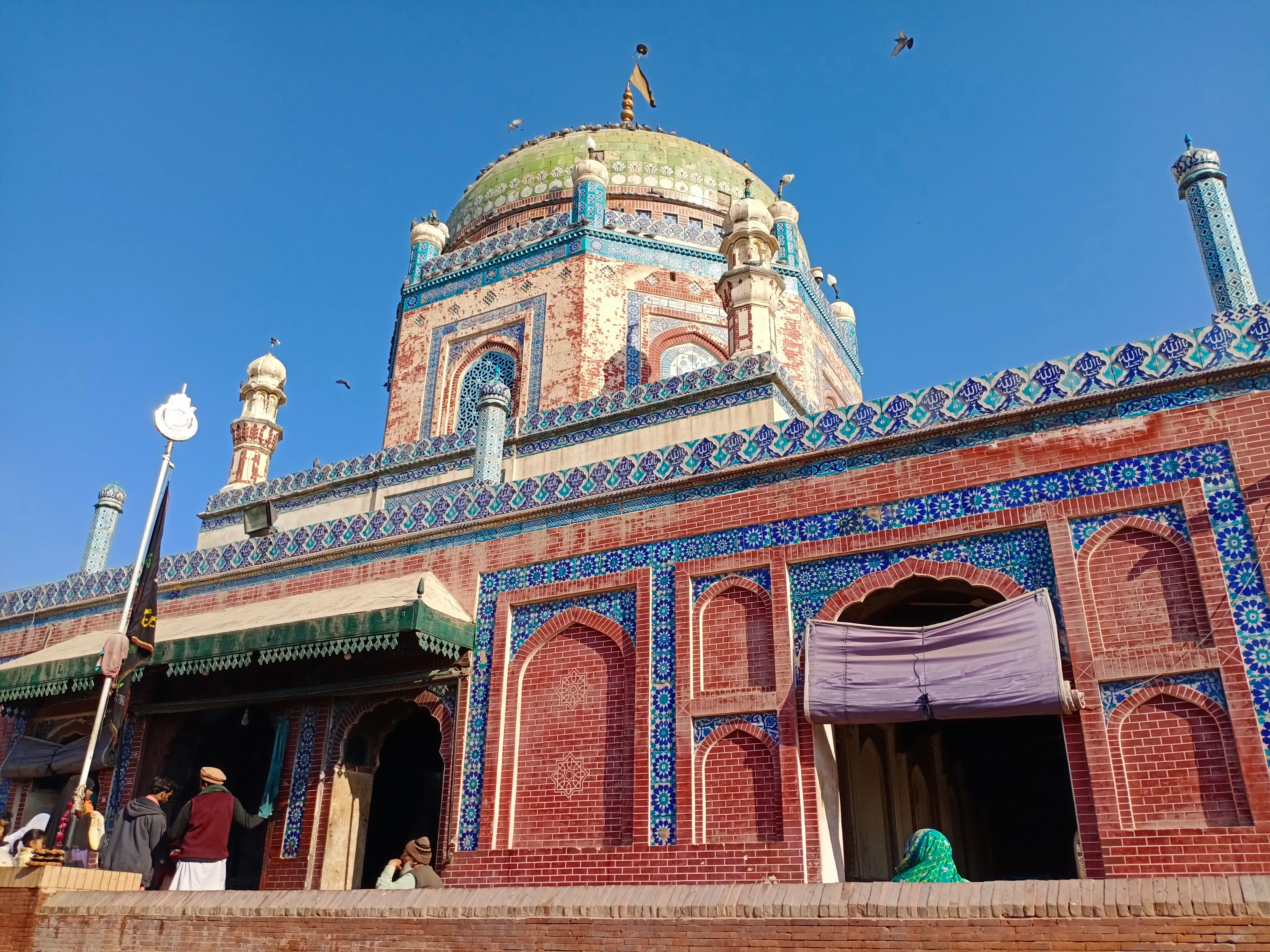
If you see one thing in Multan, it will almost certainly be this. The tomb of Shah Rukn-e-Alam is considered one of the most impressive shrines in the Indian subcontinent and the earliest known example of Tughluq architecture — predating the Tughluq monuments in Delhi. Built between 1320 and 1324 by Ghiyas-ud-Din Tughluq (originally for himself), it was gifted to the descendants of Shah Rukn-e-Alam after his death in 1335, when the saint's remains were transferred here.
The architecture is the reason photographers and architects come from abroad specifically to see it. The mausoleum is built of red brick bounded by beams of shisham wood, with an exterior elaborately ornamented with glazed tile panels — dark blue, azure, and white contrasted with the deep red of finely polished bricks. The structure rises in three tiers: an octagonal base, a smaller octagon above it, and a dome that can be seen from across the city. The sarcophagus inside is slightly off-centre and surrounded by the graves of 72 relatives and disciples, symbolically alluding to the 72 companions martyred at the Battle of Karbala.
The annual Urs of Shah Rukn-e-Alam — held on the 5th to 7th of Jamadi-ul-Awal in the Islamic calendar — attracts over 100,000 pilgrims and transforms the site into one of the largest religious gatherings in Punjab. Outside the Urs, the shrine is accessible daily from early morning, with the inner courtyards most atmospheric in the early hours before the midday heat. The shrine is located on the northwestern edge of Multan Fort, and the elevated position gives good views across the city.
"When exploring the rest of Multan, all the other tombs come across as miniature imitations of this mausoleum. None quite match the splendour or the size."
— Orphaned Nation, on Shah Rukn-e-Alam
Bahauddin Zakariya Shrine
A short walk from Shah Rukn-e-Alam, the older shrine of his grandfather sits in the northern corner of the ancient fort. Bahauddin Zakariya was born around 1170 in Layyah district, travelled to Baghdad for his religious education under Sheikh Shahab-ud-Din Suhrawardi, and eventually settled in Multan in 1222, where he spent the rest of his life establishing the Suhrawardiyya order — the dominant Sufi lineage across medieval South Asia. He died in 1267.
The tomb was built in 1262 — approximately six years before the saint's death, which was not unusual for senior religious figures of the period. It set the prototype for the distinct architectural style followed by many later shrines in Multan: a square base, an octagonal tier above, and a white dome, decorated with what became the signature blue Multani tilework. The structure is similar in form to Shah Rukn-e-Alam's tomb but more restrained — and arguably more spiritually charged for it.
This mausoleum is particularly known for its qawwali nights — devotional music played on the harmonium after evening prayers, when Muslims from across Multan gather in the courtyard, sit on the ground, and sway while the sound resonates into the night. Thursday evenings are when qawwali gatherings are most reliably active at this shrine. Devotees approach the interior with flowers in hand, praying in front of the casket and scattering pink flower petals over the tomb as a gesture of respect. For a foreign visitor, this is the shrine where the living devotional tradition is most visibly on display.
Shah Shams Tabriz Shrine
Shah Shams Sabzwari — also known as Shah Shams Tabriz or Shams-e-Tabriz — is the most historically intriguing figure in Multan's shrine circuit, because of his connection to Rumi. Shams al-Din Muhammad, the Persian mystic who served as the spiritual teacher and transformative companion of Maulana Jalal-ud-Din Rumi, is revered in Rumi's collection the "Divan-e-Shams-e-Tabrizi." Whether the Multan shrine holds his remains or those of a namesake saint is a matter of scholarly debate that has persisted for centuries — local tradition holds that it is the Shams of Rumi, which is why devotees of Rumi's poetry have been making the journey to Multan for generations.
Shah Shams came to Multan in the 12th–13th century and preached a message of humanity, respect, and peace. He died in 1276, and the current tomb was built approximately 54 years later by his grandson — a gesture of deliberate simplicity that reflects the saint's own ascetic character. The shrine is built almost entirely of sky-blue engraved glazed bricks, making it one of the most distinctive in colour tone among Multan's major mausoleums, and its green dome marks it from a distance.
The shrine has earned a reputation as one of Multan's major cultural centres — while the other shrines attract tourists alongside pilgrims, here you will see more Sufi traditions and rituals actively taking place. The sprawling bazaar that runs up to its walls adds to the liveliness: this is a working neighbourhood shrine as much as a heritage destination, and the atmosphere is consequently less curated than at Shah Rukn-e-Alam.
Musa Pak Shaheed Shrine
The fourth of Multan's major shrines sits near Pak Gate inside the old walled city — smaller in scale than the other three but with a distinct architectural character and spiritual story. Syed Abul Hassan Musa Pak Shaheed was a descendant of Abdul Qadir Jillani, the founder of the Qadiri Sufi order, born in Uch Sharif. He was martyred in 1592 during a civil conflict of the Langah tribe, and the title "Shaheed" — martyr — forms the core of his veneration. His annual Urs draws devotees particularly from families affiliated with the Gilani lineage, which traces descent from the same Abdul Qadir Jillani.
The shrine complex comprises a single-dome tomb and an adjacent mosque. The exterior decoration, including blue-glazed tilework, was refurbished in the early 20th century, giving it a cleaner appearance than the more weathered major shrines. The interior is more intimate than Shah Rukn-e-Alam or Bahauddin Zakariya — it's the kind of shrine where you can sit quietly for a while rather than navigating crowds. For visitors with a specific interest in the Qadiri tradition or in the genealogical complexity of Multan's Sufi families, this is the most layered of the four in terms of historical backstory.
Visiting Etiquette: What to Wear, When to Go, Photography
Multan's shrines are not tourist attractions in the conventional sense — they are active places of pilgrimage that happen to be open to foreign visitors. That distinction shapes the etiquette more than any specific rule.
Dress: Modest clothing covering arms and legs at all sites. Women should bring a scarf to cover their hair when entering the main shrine buildings — not just at the entrance, but throughout the inner chambers. Avoid shorts, sleeveless tops, or anything with graphic imagery. In practice, loose, covering clothing is also far more comfortable in Multan's heat than alternatives.
Shoes: Removed before entering inner courtyards and prayer areas at all the major shrines. There are designated shoe-keeping areas at the entrances — leave a small tip when collecting. Bring socks if you're uncomfortable walking barefoot on warm marble.
Photography: Generally tolerated in outer courtyards and on the exterior, and the tile work and architecture of Shah Rukn-e-Alam in particular is photographed constantly. Inside, near the tombs themselves, be more discreet — ask before photographing, and never photograph people in prayer without permission. Avoid photographing women without consent.
Timing: Early morning gives better light and cooler temperatures, and the major shrines are quieter before 9 or 10 am. Thursday evenings at Bahauddin Zakariya for qawwali. Avoid Multan entirely between May and July — the heat is severe enough to make outdoor movement genuinely difficult.
The Urs: What Happens at a Sufi Death Anniversary Festival
If your timing aligns with an Urs — the annual commemoration of a Sufi saint's death — you'll experience Multan at a different register entirely. The term "Urs" comes from the Arabic word for wedding, and the metaphor is deliberate: in Sufi tradition, the saint's death is understood as a reunion with God, not a loss to be mourned but a union to be celebrated.
In practice, an Urs at a major Multan shrine involves several days of qawwali performances, communal prayers, large crowds of pilgrims who may have travelled from considerable distances, the scattering of rose petals over the tomb, and a general intensification of everything you'd experience at the shrine on an ordinary day. The Urs of Shah Rukn-e-Alam, held on the 5th to 7th of Jamadi-ul-Awal, draws over 100,000 pilgrims — a number that makes it one of the largest religious gatherings in Punjab.
For a foreign visitor, an Urs is genuinely worth timing around if you can. It's also worth being prepared: crowds are dense, the inner shrine can be almost impossible to enter during peak hours, and the atmosphere is intense rather than contemplative. Going early in the morning on the first day of the Urs tends to offer the best balance between witnessing the event and having some space to actually experience the shrine itself. Because the Islamic calendar is lunar, the Gregorian calendar dates of each Urs shift by approximately 11 days per year — confirm current dates before planning.
Getting Between the Shrines: Practical Logistics
Shah Rukn-e-Alam and Bahauddin Zakariya are both on the elevated ground of the old Multan Fort and are within easy walking distance of each other — plan an hour at each. Shah Shams Tabriz is a short rickshaw ride away, deeper into the bazaar area around the old city. Musa Pak Shaheed is near Pak Gate, also within the walled city.
All four can be covered in a single full day if you start early, but the experience is richer if you allow two days: one morning for Shah Rukn-e-Alam and Bahauddin Zakariya, including the surrounding Multan Fort area and the Hussain Agahi Bazaar for blue pottery, and a second morning for Shah Shams Tabriz and Musa Pak Shaheed, with a Thursday evening return to Bahauddin Zakariya for qawwali if your schedule allows. Rickshaws are plentiful and cheap for getting between sites; negotiate the fare before getting in. Carry cash in small denominations — cards are not accepted at any of the shrines.
For the broader Multan picture — including where to stay, how to get there from Lahore or Islamabad, the heat, and what else the city offers — see our complete Multan travel guide. Multan also features as a centrepiece of our Grand Cities of Pakistan Tour, which pairs it with Lahore, Mohenjo-daro, and Pakistan's other great heritage cities in a single private itinerary.
Frequently Asked Questions
Multan earned the title because it became one of the most important centres of Sufi Islam in South Asia from the 11th century onwards. The city attracted a remarkable concentration of Sufi mystics — including Bahauddin Zakariya, founder of the Suhrawardiyya order in the subcontinent, and Shah Rukn-e-Alam. Within a 25-mile radius of the city centre, there are estimated to be hundreds of mausoleums of saints and their followers.
Yes — the major shrines in Multan, including Shah Rukn-e-Alam and Bahauddin Zakariya, are open to visitors of all faiths. The expectation is respectful behaviour: modest dress covering arms and legs, shoes removed before entering the inner shrine, and a scarf for women. Photography is generally tolerated in the outer courtyards but should be done discreetly — ask before photographing inside prayer areas or close to the tombs.
An Urs is the annual death-anniversary commemoration of a Sufi saint — celebrated as a union with the divine rather than mourned as a loss. It typically involves several days of qawwali devotional music, communal prayers, and large crowds of pilgrims. The Urs of Shah Rukn-e-Alam falls on the 5th to 7th of Jamadi-ul-Awal in the Islamic calendar and draws over 100,000 pilgrims. Because the Islamic calendar is lunar, the Gregorian dates shift each year — check the current year's dates before planning if you want to align your visit.
Modest clothing that covers arms and legs is expected at all the shrines — this applies to all visitors regardless of gender. Women should carry a scarf to cover their hair inside the main shrine buildings. Shoes must be removed before entering inner courtyards and prayer areas; there are designated shoe-keeping areas at the entrances of the major shrines, typically for a small tip.
The major Sufi shrines in Multan — including Shah Rukn-e-Alam, Bahauddin Zakariya, and Shah Shams Tabriz — are free to enter. There is no official ticket booth. Small tips to shoe-keepers and donations at the shrines themselves are customary and appreciated. Keep small rupee notes for this.